
Side Dishes
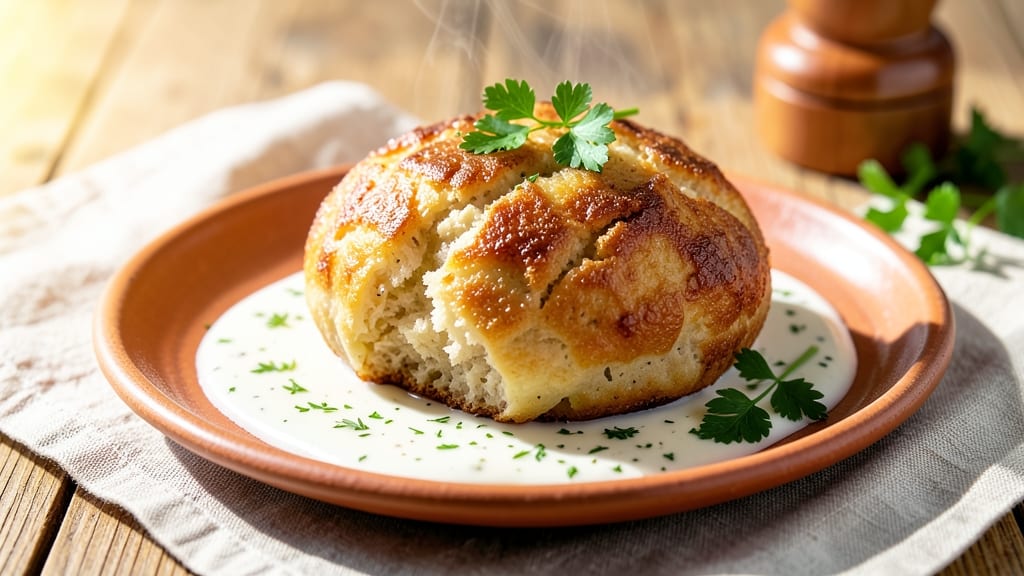
Austrian bread dumplings transform simple ingredients into pillowy clouds that melt in your mouth. 💛 The secret lies in the perfect balance of stale bread, eggs, and milk—creating a dough that boils into tender, fluffy knots perfect for soaking up rich gravy.
These dumplings are the heart of Austrian comfort food, often served alongside hearty stews or melted with cheese for a cheesy delight.
What makes these dumplings truly special is their fail-safe texture—no overmixing, no guessing. The dough comes together in minutes, then boils gently until light and airy. The key is shaping them carefully to ensure they hold their form while cooking.
Whether you're serving them as a side or a main, they'll disappear faster than you can say "Semmelknödel."
Pair these dumplings with a classic brown gravy or melted Gruyère cheese for the ultimate Austrian experience. The contrast of tender dumplings and savory sauce creates a dish that feels like a warm hug on a chilly day.
Ready in about 30 minutes, this recipe delivers restaurant-quality results with minimal effort.
The beauty of Austrian bread dumplings is their versatility. Use them as a side for roasted meats, a base for soups, or even a standalone dish with a sprinkle of parsley. The possibilities are endless, but the technique remains simple—just a few ingredients and patience for the perfect bite.
Ingredients for austrian bread dumplings
Nine simple ingredients create these melt-in-your-mouth Austrian bread dumplings that pair perfectly with savory gravy.
| Ingredient | Amount | Notes |
|---|---|---|
| Stale White Bread 🍞 | 4 cups | Day-old or lightly toasted, cubed |
| Large Eggs 🥚 | 4 whole | Room temperature for best mixing |
| Whole Milk 🥛 | 1 ½ cups | Full-fat preferred for richness |
| Unsalted Butter 🧈 | 2 tbsp | Cold, cubed for easier handling |
| Salt 🧂 | 1 tsp | Fine sea salt preferred |
| Fresh Parsley 🌿 | ¼ cup | Chopped, for garnish |
| Vegetable Oil 🫒 | ½ cup | For boiling water |
| Gruyère Cheese 🧀 | 1 cup | Shredded, for optional topping |
| Beef Broth 🍲 | 2 cups | Homemade or quality store-bought |
| All-Purpose Flour 🌾 | ¼ cup | For dusting work surface |
| Fresh Thyme Leaves 🌿 | ⅛ cup | Optional, for gravy |
The bread is the star—day-old white bread works best, but lightly toasted cubes also give great texture. Bread bins at grocery stores often have discounted stale loaves perfect for this. If you can't find stale bread, toast a fresh loaf and let it cool completely. The milk should be full-fat for that rich, tender result—whole milk from the dairy section is ideal. For the butter, grab the coldest stick from the fridge so it stays firm when you cube it. This makes shaping the dumplings much easier later. If you're feeling fancy, use Gruyère cheese from the specialty cheese counter—it melts beautifully over the dumplings.
No stale bread? Toast fresh bread and let it cool completely—it'll dry out enough overnight. Short on milk? Evaporated milk or half-and-half works in a pinch, though the texture won't be quite as tender. The Gruyère can be swapped for sharp cheddar or Parmesan if that's what you have. For the parsley, fresh is ideal but dried parsley at one-third the amount gets you close. The beef broth is crucial for the gravy—low-sodium versions let you control the salt better. If you're making gravy, Trader Joe's or Whole Foods have great pre-made options that save time. The thyme is optional but adds a lovely aroma to the gravy—dried thyme works too if you're out of fresh.
These dumplings reheat beautifully—just a few minutes in the oven with extra broth brings them back to their pillowy best. Store leftovers in the fridge for up to 3 days, covered with broth or gravy to keep them moist. For longer storage, freeze them for up to 2 months—just thaw overnight in the fridge before reheating. The gravy can be made ahead and reheated separately. I like to portion the dumplings into individual servings before freezing so they're ready to pop into the oven whenever I crave comfort food.
Why You'll Love This Recipe
- Pantry Magic: I swear by this trick—no fresh bread needed. Toss in yesterday’s crusts, soak ‘em in milk, and boom: dinner’s sorted. (Yes, even when you forgot to grocery shop.)
- Buttery Soft Core: That melt-in-your-mouth texture? It’s all in the butter—just a few tablespoons mixed into the dough. Rich, tender, and exactly what you need when you’re craving something comforting but not heavy.
- Weeknight Workhorse: Serve them under gravy for a hearty meal, alongside roasted veggies for a light lunch, or even as a side to soup. Honestly, I’ve lost count of how many ways I’ve repurposed these—always hits.
- Zero-Waste Goldmine: Turns stale bread into something spectacular with almost no effort. Plus, the leftovers reheat like a dream—just a splash of milk and a minute in the microwave. Budget-friendly and practical? That’s my kind of recipe.
Step-by-step instructions for Austrian bread dumplings
Transform simple ingredients into heavenly, pillowy bread dumplings that melt in your mouth.
👨🍳 Step 1: Prepare the Bread Mixture
Tear the 4 cups stale white bread into rough chunks and place them in a large bowl. This texture ensures they absorb the liquid properly without forming a dense mass. Add the 1.5 cups whole milk and 4 whole large eggs to the bowl, then sprinkle in the 1 tsp salt. Use your hands to gently work the mixture together until it forms a thick, shaggy dough.
Here's the thing—don't overmix. You want a rustic, uneven texture that holds together when shaped but still has pockets of air for that signature fluffy interior. The dough should be moist but not sticky; if it feels too wet, add 2 tablespoons unsalted butter cut into small cubes and work them in. Let the mixture sit for 5 minutes while you prepare the boiling water.
🔥 Step 2: Boil and Shape the Dumplings
Bring a large pot of water to a rolling boil using 0.5 cup vegetable oil (this prevents the dumplings from sticking). The oil also helps create a delicate skin on the outside. While the water heats, dust your work surface with 0.25 cup all-purpose flour—this prevents the dough from sticking as you shape.
Using slightly wet hands (dip in cold water if needed), scoop the dough into 4 equal portions (about 1 cup each). Roll each portion into a smooth ball, then gently flatten into a 3-inch diameter circle. Here's where it gets fun—poke your finger through the center of each circle to create a hole, then stretch the edges slightly to form a ring. Drop them carefully into the boiling water.
🍳 Step 3: Cook Until Golden and Fluffy
Cook the dumplings for 8-10 minutes until they float to the surface and turn golden brown on the bottom. This is your visual cue—they're ready when they look like delicate, puffed-up clouds. Use a slotted spoon to transfer them to a paper towel-lined plate to drain briefly.
Don't let them sit too long or they'll lose their fluffiness. While they drain, prepare the savory gravy by melting the remaining 2 tablespoons unsalted butter in a saucepan over medium heat. Add 2 cups beef broth and bring to a gentle simmer. Stir in the 0.125 cup fresh thyme leaves and let it infuse for 2 minutes—this adds depth to the gravy.
🥘 Step 4: Assemble and Serve
Return the drained dumplings to the simmering gravy and let them soak for 2-3 minutes, allowing them to absorb the rich, herby broth. The dumplings should be light as air with a tender, almost custard-like interior. For extra indulgence, sprinkle with 1 cup shredded Gruyère cheese while they warm through.
Garnish with 0.25 cup chopped fresh parsley just before serving. These dumplings are best enjoyed immediately while still warm and pillowy. Pair them with pan-seared chicken or a hearty beef stew for the ultimate comfort meal.
Pro Tips For Making Austrian Bread Dumplings
- Tear Bread by Hand: Skip the food processor—your fingers work better. Ripping stale bread into uneven chunks (about 1-inch) gives the dumplings more surface area to soak up milk and butter, which makes them creamier. I learned this the hard way after blending bread too finely and ending up with dense, gluey dumplings.
- Warm the Milk First: Heat the whole milk to just under boiling (about 160°F/70°C) before mixing it with the bread. Cold milk makes the dough gummy, and warm milk helps the bread absorb it faster and more evenly. Pour it into the mixing bowl, then add the bread—it’ll soak up the liquid like a sponge.
- Don’t Overmix the Dough: Stir the bread, milk, egg, and butter just until combined—maybe 10-12 turns with a wooden spoon. Overmixing develops gluten, and these dumplings should be tender, not chewy. If the dough looks shaggy, that’s fine; it’ll hold together when shaped.
- Boil in Batches: Drop dumplings into simmering water (not boiling) in small batches—no more than 3-4 at a time. Crowding the pot lowers the temperature, and they’ll turn out mushy instead of fluffy. Use a slotted spoon to gently lower them in, and let them cook undisturbed for 5-6 minutes before turning.
Perfect pairings for this dish
Classic Gravy Pairing
Serve your bread dumplings with a rich beef gravy made from the same broth used in their cooking. Simmer 2 cups beef broth with 2 tbsp unsalted butter and ¼ cup fresh thyme leaves for 5 minutes to infuse flavor.
The dumplings will soak up the gravy beautifully, creating a comforting, hearty dish. 🥘
Cheesy Käsespätzle Style
For a true Austrian twist, top your dumplings with melted Gruyère cheese (or sharp cheddar) while they warm. Sprinkle 1 cup shredded cheese over the dumplings and cover the pan for 2-3 minutes to let it melt into a gooey blanket. Finish with fresh parsley for a restaurant-worthy presentation.
Herb Butter Enhancement
Elevate your dumplings with a dollop of herb butter—mix 2 tbsp softened butter with 1 tsp chopped chives and ½ tsp lemon zest. Spoon this over the dumplings just before serving for a bright, aromatic contrast. The butter adds richness without overwhelming the dish.
Crispy Pan-Fried Topping
For extra texture, pan-fry the dumplings after boiling. Heat 1 tbsp butter or oil in a skillet over medium heat and cook the dumplings for 2-3 minutes per side until golden brown. This creates a crispy exterior that contrasts perfectly with the soft interior.
Vegetable Sauté Pairing
Balance the richness of the dumplings with a simple sautéed vegetable medley. Cook 1 cup sliced mushrooms, 1 cup bell peppers, and 1 cup onions in 1 tbsp butter for 5-7 minutes until tender. The earthy flavors complement the dumplings wonderfully, adding freshness to the plate.
Sweet-Savory Contrast
For a unique twist, serve the dumplings with a side of apple compote. Simmer 1 cup diced apples, 1 tbsp brown sugar, and 1 tsp cinnamon for 10 minutes until thickened. The sweet-tart contrast cuts through the savory richness of the dumplings, creating a balanced bite.
Nutrition facts
Frequently asked questions
Can I use fresh bread instead of stale bread?
Fresh bread works in a pinch, but stale bread is ideal for its dry texture. If using fresh, lightly toast the cubes first and let them cool completely. The bread should crumble easily when mixed with milk—if it's too moist, add an extra 1 tablespoon of flour to absorb excess liquid.
Why did my dumplings turn out dense instead of fluffy?
Dense dumplings usually mean overmixing or insufficient resting time. The dough should be shaggy, not smooth—handle it gently and avoid kneading. Also, ensure the water is boiling vigorously before adding the dumplings, and cook them until they float (about 8-10 minutes).
How do I store leftover bread dumplings?
Store cooked dumplings in an airtight container with a splash of broth or gravy to keep them moist. They’ll stay fresh in the fridge for 3 days or freeze for 2 months. Reheat in a 350°F oven for 10-15 minutes with extra broth to restore their pillowy texture.
Can I make these dumplings ahead of time?
Shape the dough into rings and refrigerate them on a floured tray for up to 24 hours before boiling. This makes assembly easier. For the gravy, prepare it fresh or reheat stored gravy with a splash of broth to thin it out. The dumplings reheat beautifully with a quick dip in simmering broth.
What’s the difference between these and German spaetzle?
German spaetzle are made with just flour, eggs, and water, pressed through a spaetzle board for ribbons. Austrian bread dumplings use stale bread, milk, and butter, shaped into rings for a softer, custard-like interior. Both are delicious, but bread dumplings have a richer, more tender texture.